14 July 2026
Tax Lawyers in Croatia
Our tax lawyers in Croatia inform you on the most relevant aspects of taxation in Croatia. If you are interested in Croatia tax rates, talk to our advisors.
Since its European Union accession in 2013, Croatia has been a rapidly developing economy with continuous modernizations of its commercial legislation. Thanks to its coastal region, this country is an important touristic center for seaside holidays and thus an attractive location for investments. The primary taxes in Croatia are the income tax (levied on wages and income interest), the VAT (the value added tax) and the profit tax (imposed on the profit of an enterprise). The taxes in Croatia are often subject to modifications in response to the dynamic economy and frequent legislation reformulations. Therefore we strongly recommend you to employ a tax lawyer in Croatia to keep you informed on the latest tax related information.
Income tax in Croatia
Depending on the amount, an individual’s annual taxable income is subject to different income tax rates. Since 2024 there are two brackets (threshold EUR 60,000 since 2025), with rates set by each municipality or city:
- A lower rate of 15% to 23% (20% by default) applies to annual income up to EUR 60,000;
- A higher rate of 25% to 33% (30% by default) applies to annual income above EUR 60,000;
- The former 20%/30% rates and the local surtax (prirez) no longer apply.
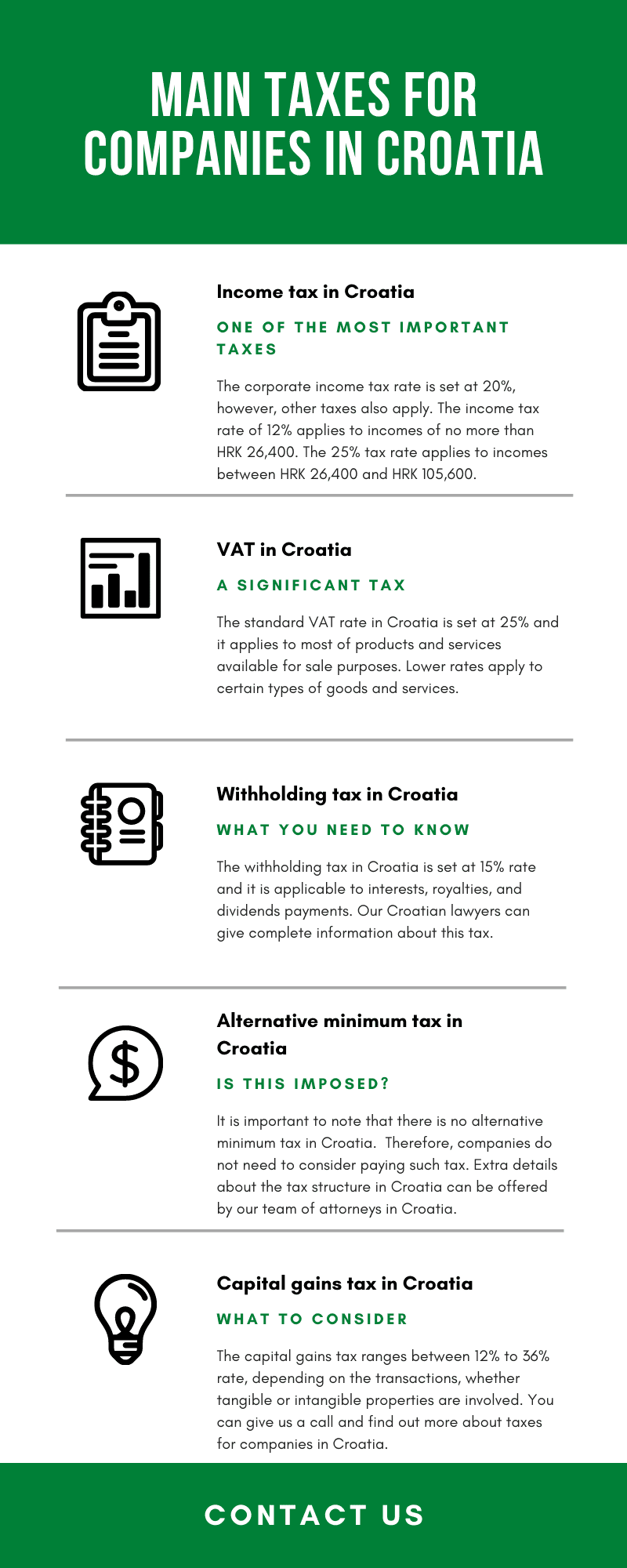
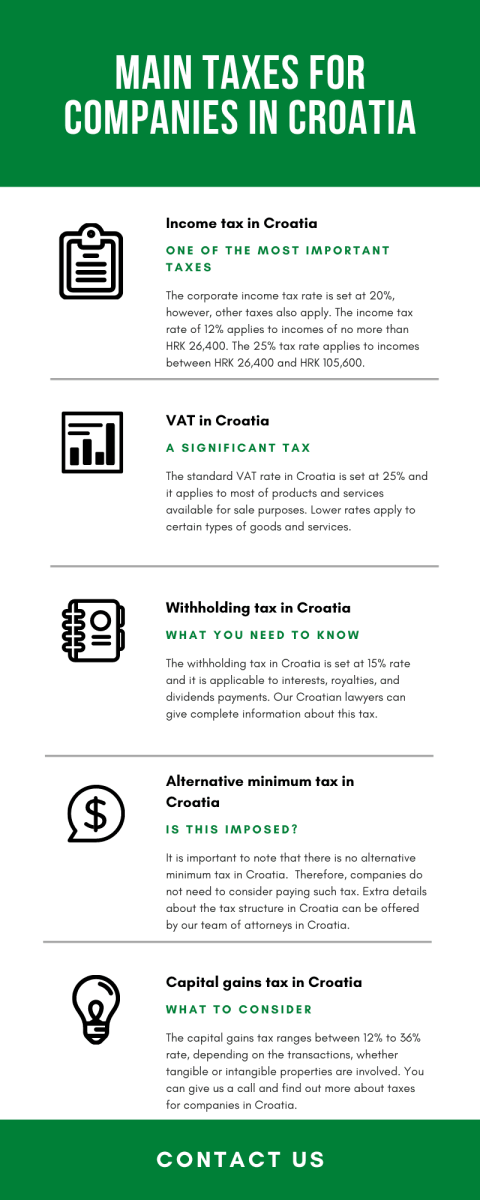
For more information on income tax and for a professional counseling on this topic, you can rely on our tax lawyers in Croatia. You can also find useful the following infographic:
Value added tax in Croatia
Any person who carries out an economic activity involving goods or services, valuing more than EUR 60,000 in the previous or current calendar year, is obliged to register with the VAT Register for an identification number. If the taxpayers are based in another country of the EU, they can employ a tax representative. There are three VAT rates in Croatia: 25%, 13% and 5%. The standard rate is 25%. The reduced rate of 5% applies to products such as:
- baked bread and milk;
- newspapers, magazines, books and scientific journals;
- cinema tickets;
- medicines and surgical products, medical equipment; concert tickets, baby food, edible oils and fats.
The 13% rate VAT applies to the following (baby food, oils and fats and concert tickets have moved to the 5% rate):
- hotels and accommodation services;
- restaurant services;
- oils and fats;
- baby food;
- sugar and products from sugar;
- concert tickets;
- water supply.
The corporate income tax in Croatia
The corporate income tax or CIT is set at 18% in Croatia and it is quite beneficial from a business point of view. A lower CIT of 10% rate applies to companies (taxpayers in Croatia) with revenues lower than EUR 1,000,000 registered in the tax period. Branches of foreign companies in Croatia, companies controlling shares in capital, and even natural persons are subject to CIT. In the case of the last category of taxpayers, they can choose not to pay the personal income tax or PIT, and instead be levied with CIT. Croatia’s tax rate can be explained by one of our Croatian tax lawyers who can also help entrepreneurs register for taxation in this country.
Are there residence rules for taxation purposes in Croatia?
Foreigners with residence of at least 183 days in Croatia are considered residents who need to pay taxes in Croatia. These are taxpayers who must register for taxation in Croatia. In the case of individuals with residence in Croatia and the country of origin, the taxation is made in the country where the family lives. We remind you that it is important to notify the authorities in Croatia and especially the Tax Administration (Porezna uprava) if you no longer live in Croatia or you closed the business activities in this country. This procedure is made to report the tax changes and to avoid paying taxes if you no longer have activities in Croatia. More about Croatia tax rate can be discussed with one of our advisors who can also help foreigners start a business in Croatia.
The property tax rate in Croatia
The property tax in Croatia is imposed on buildings and lands, alongside the VAT for property sales. Here is what you need to know about the property tax in Croatia:
- The real estate transfer tax rate is 3% in Croatia and it applies to sold properties (inherited or gifted properties are subject to the 4% inheritance and gift tax, with exemptions for close family members).
- The 25% VAT rate is imposed on the first supply of new buildings in Croatia (instead of the transfer tax). This is normally calculated on the price of the property.
- Since 2025, the former holiday-home tax has been replaced by an annual property tax on properties not used for permanent residence or long-term rental. This ranges between EUR 0.60 and EUR 8.00/square meter, as set by the local authority.
- An annual tax rate for rented properties in Croatia is imposed for persons who own such properties for touristic purposes.
Interested in more about the property tax rate in Croatia? Feel free to send your inquiries to our Croatian tax lawyers. It is important to know more about Croatia tax rate if you intend to start a business in this country.
FAQ about taxation in Croatia
1. What is the corporate tax rate in Croatia?
The corporate tax rate in Croatia is set at an 18% rate and it is imposed on profits generated in Croatia. There are lower rates applicable, yet more details can be discussed with our Croatian tax lawyers.
2. What is the VAT rate in Croatia?
25% rate is the standard VAT in Croatia imposed on goods and services for sale purposes. Lower rates apply for specific foodstuff, utility services, hotel accommodation, water supply, and more.
3. What is the capital gains tax in Croatia?
The capital gains tax for individuals is set at a 12% rate (since 2024), while companies pay profit tax (18% or 10%) on their gains. Interested in more about Croatia tax rate? You can talk to our Croatian tax lawyers.
4. Is there a wealth tax in Croatia?
No, there is no wealth tax in Croatia and it is considered a relief and a great advantage for entrepreneurs from overseas and natural persons who own different assets.
5. Is Croatia a tax haven?
Croatia is appreciated from a tax point of view by international entrepreneurs who benefit from lower taxes and other tax advantages. It is not a tax haven, but an EU Member State applying EU tax directives and the global minimum tax.
Making investments in Croatia
Croatia is a safe and highly appreciated country from a business point of view. A large number of foreign enterprises is proof that the business environment in Croatia comes with varied benefits. Besides the advantageous tax regime, the experienced workforce, the stable economy, the extended emerging market, and the possibility of doing business in most sectors of interest are among the benefits of Croatia in front of international entrepreneurs. Here are some interesting facts and figures about Croatia’s economy and business:
- Nearly USD 30 billion was the total FDI stock for Croatia in 2019.
- The World Bank discontinued its Doing Business report in 2021; its last (2020) edition ranked Croatia 51st out of 190 economies in the world, referring to the ease of doing business.
- Around 30% of the total FDIs registered in Croatia in 2019 was directed to the financial services sector.
- The Netherlands is the main investor in Croatia, with more than 20% of total FDI registered between 1993 and 2017.
Don’t hesitate to contact our Croatian tax attorneys, for in-depth help regarding the obtaining of your VAT identification number and for competent legal advice on Croatian taxation issues.